
Public school funding is VERY complicated, but this will give you a good general understanding of how it works in our district.
ISD 728 has several funds, or pools, that it can draw from to pay for district costs. The general fund is the largest fund, containing about 82% of the total district revenue. The bulk of the general fund pays for the salaries/wages and benefits of our staff, teachers, paraprofessionals, custodians, food service, administrative assistants, administrators, superintendent, etc. Most of the rest of this fund goes toward supplies and materials and purchased services like transportation. The chart below shows how the general fund is estimated to be used for the 2025-2026 school year.
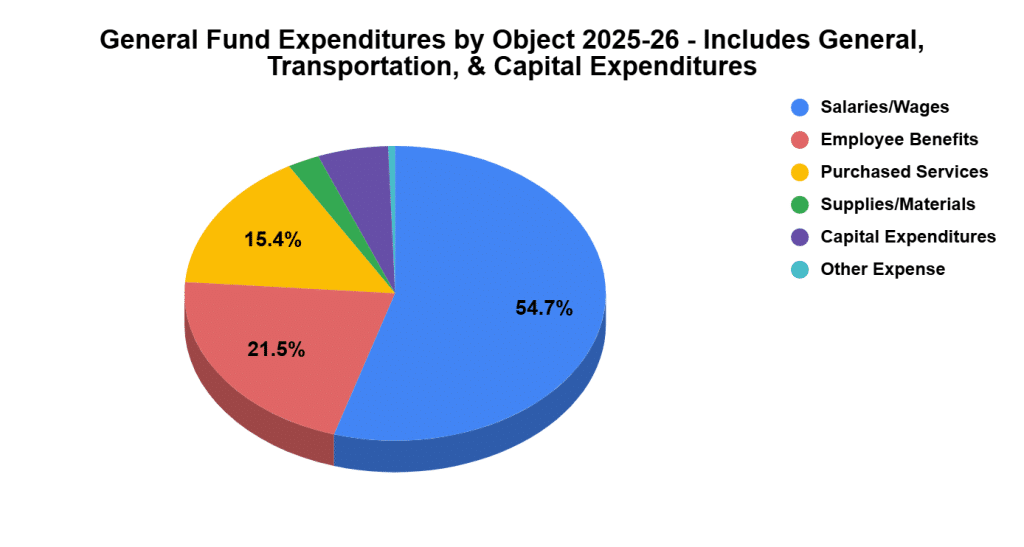
Aside from the general fund, other smaller funds are assigned for specific things like community ed, food service, building construction, district debt, and retirement benefits. These funds can only be used for costs that fall under each category. If the district has an overage in food service, for example, they cannot use those extra funds for building construction or teacher salaries. They also cannot transfer those funds to any other fund for use. Those funds must remain in the food service fund and must be used for costs associated with that fund. These fund regulations are determined by the state legislature.
This year, ISD 728 will receive about 72% of its general fund revenue from state funding. An additional 22% comes from local property tax levies, and the remaining amount comes from various sources like county and federal sources and investment income.
Most of our state funding is based on the number of students enrolled in a district, with a predetermined amount provided per student. Called Per Pupil Unit (PPU), this amount is calculated differently depending on the grade level of the student(s) enrolled.
Increases in state funding per student have not kept up with inflation over at least the past 18 years. Additionally, chronic underfunding of special education and English Learner (EL) services continues to shift significant costs onto districts. This further widens the gap between state funding and actual expenses. For our district, this has resulted in a current difference in funding amounting to $1453 per student per year as compared to funding in 2008. At 14,000 students, this discrepancy adds up to over $20 million in decreased revenue per year for our district. Funding discrepancies like this have left school districts with an increasing need to rely on local property tax referendums to provide reliable funding for operational costs.
If a school district finds the need to increase funding beyond what is already being received, generally they must do so through a voter-approved referendum. A referendum is included on election ballots and requires a majority of local voters to approve the requested additional funding. If approved, this funding is obtained via property tax increases spread over a period of time.
When a referendum is used to supplement annual operating costs, it is called a levy. Levies pay per student, which allows for revenue to adjust as enrollment goes up or down within a district. Levy money typically goes into the district’s general fund to pay for operational costs like salaries and supplies.
If a levy fails at the ballot, school boards may use a limited levy authority to generate some additional funding. However, this type of levy is more costly for taxpayers and generates less revenue for the district. This makes it a less effective long-term solution and often does not fully meet district needs.
When a referendum is used for renovation or construction, it is called a bond. Because bonds fund projects, they are funded based on a total requested amount rather than the number of students. Bond money typically goes into a capital projects fund to pay for construction, renovation, or facility improvements. This means that this funding is not available to be used for other costs outside these areas. It must remain within this fund.
Want an easy way to remember which kind of referendum pays for what? Bonds are for Buildings; Levies are for Learning.
To learn more about public school funding, look for school board meetings that have budget or “truth in taxation” listed in the agenda.
📣 ACTION ITEM: Want to see our public schools more fully funded? Email, call, or write your local state representative and ask them to advocate for bringing state funding current with inflation. To find your state representative: https://gis.lcc.mn.gov/iMaps/districts/
All statistics and charts above taken from truth in taxation presentation from 12/8/25 ISD 728 school board meeting: https://docs.google.com/presentation/d/1ibrpemU6PgZbuBHI2-MOHKdNMdG43yO1eK3fQZmc6sY/edit
More information about state education funding available at MN PreK-12 Education Finance System Overview 2025: https://www.house.mn.gov/hrd/issinfo/2025EducFinance.pdf